
PLA or PETG: which to choose for your 3D printed part
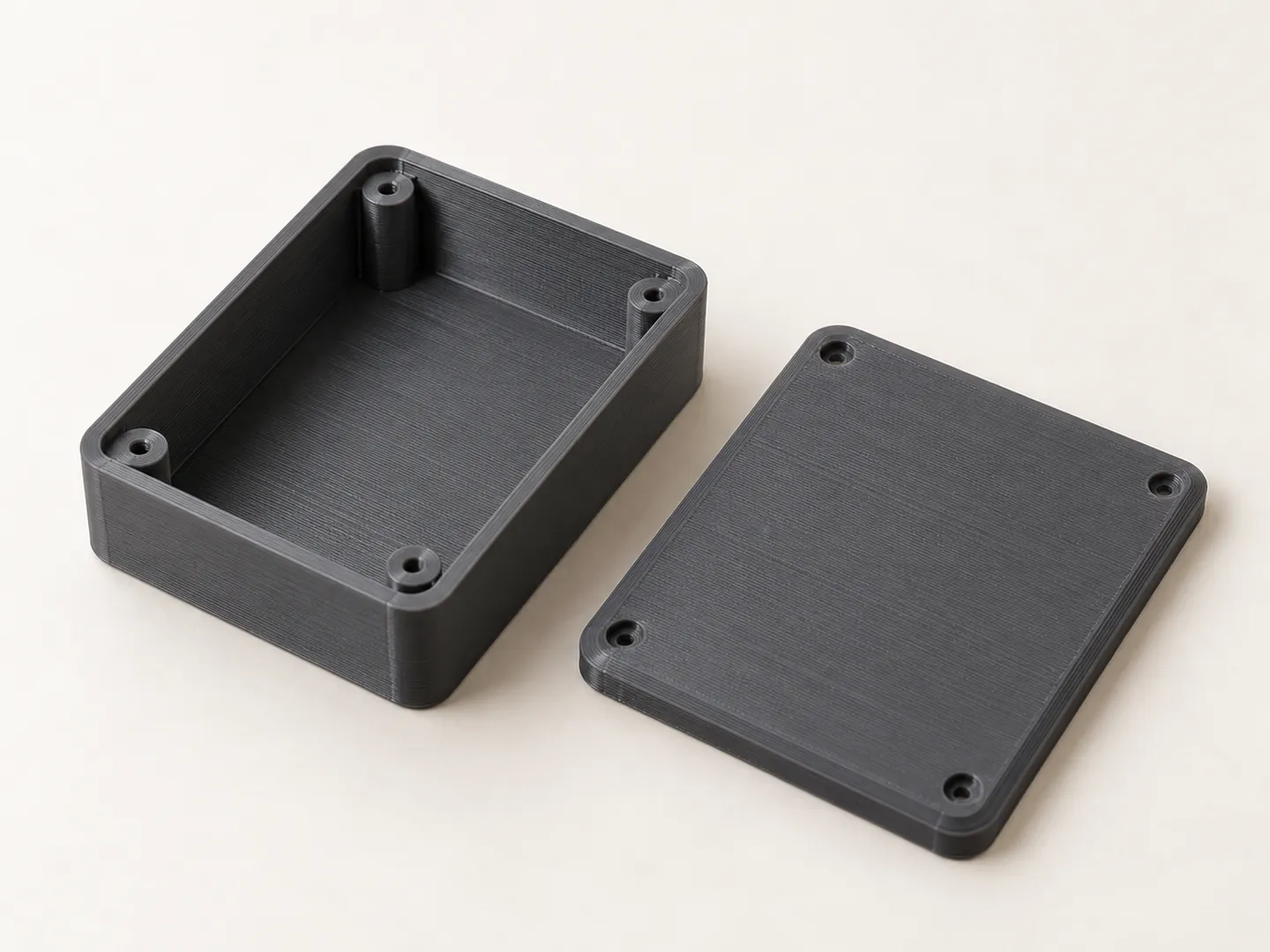
Short answer: choose PLA if the part will live indoors, at room temperature and without hard knocks: models, prototypes, organisers, figures. Choose PETG if the part has to work: brackets that carry weight, parts that get wet, take impacts or may go above 55 °C (a car in the sun, near an engine). If it will sit in full sun or above 70 °C, use neither: ASA is better.
The differences in one table
Technical data of the filaments we use in the workshop (Bambu Lab PLA Basic and PETG Basic) and prices from our calculator:
| PLA | PETG | |
|---|---|---|
| Softens from | ≈ 57 °C | ≈ 69–71 °C |
| Tensile strength | 39 MPa | 51 MPa |
| Impact strength | 26.6 kJ/m² | 34.2 kJ/m² |
| How it breaks | rigid, snaps | slightly flexible, bends before breaking |
| Water and humidity | handles splashes | very good, fine for moderate outdoor use |
| Direct sun | warps and fades | copes better, but yellows over the years |
| Finish | crispest, good detail | slightly glossy, detail a little less sharp |
| Price of a 100 g part | ≈ €16 | ≈ €21 |
Sources: technical data sheets of Bambu PLA Basic and Bambu PETG Basic. Lab specimen values: a real part depends on its design, walls and print orientation.
When is PLA better?
- Prototypes and models. It is the most accurate and the cheapest: ideal for checking sizes and shapes before the final version.
- Decorative parts and figures. Best finish and the widest range of colours.
- Organisers, light brackets, desk items. Indoors at 20–25 °C, PLA lasts for years.
The classic mistake with PLA is leaving it in a car: in summer the inside of a car can go above 50 °C, and a PLA part warps.
Our advice: do not use PLA where the part may heat up. A PLA part warped by heat can almost never be saved: in most cases the only option is to print it again in another material, PETG or ASA. If there is the slightest doubt about temperature, choose PETG from the start.
When is PETG better?
- Spare parts and mechanical parts. It is tougher: it bends a little before breaking, and clips and snap fits survive more cycles.
- Parts in contact with water. Bathroom, kitchen, garden, boat: PETG absorbs almost no water and does not degrade with humidity.
- Moderate heat. It handles up to about 70 °C: car boot, garage, near warm electronics.
Its weak point: very fine details and small text come out slightly less crisp than in PLA, and the surface is a little glossy.
A case from our workshop: an enclosure latch. We first printed it in PLA: it was too rigid and snapped at the base when clipped in. The same part in PETG had just enough flex to bend during assembly, spring back and hold the lid. For clips, tabs and snap fits, PETG is almost always the right choice.
What if neither works?
| If the part… | Better material |
|---|---|
| sits in the sun all year, in a car or outdoors | ASA |
| stays above 70 °C | ASA or ABS |
| has to bend or absorb impacts | TPU (flexible) |
| will touch food | no 3D printed material: layers trap bacteria |
Decide in 30 seconds
- Will it be in the sun or above 70 °C? → ASA.
- Does it need to bend? → TPU.
- Does it work, get wet or go above 55 °C? → PETG.
- Everything else → PLA.
Not sure? Upload the file to the calculator and tell us what the part is for in the order notes: we will recommend the material before printing, free of charge. More details on the PLA and PETG pages.